Brief Summary
|
When you receive a Decision of Rejection, you can file an appeal as explained in the separate article.
This article explains the success rates of appeals.
1. Overall Success Rate of Appeal Examinations
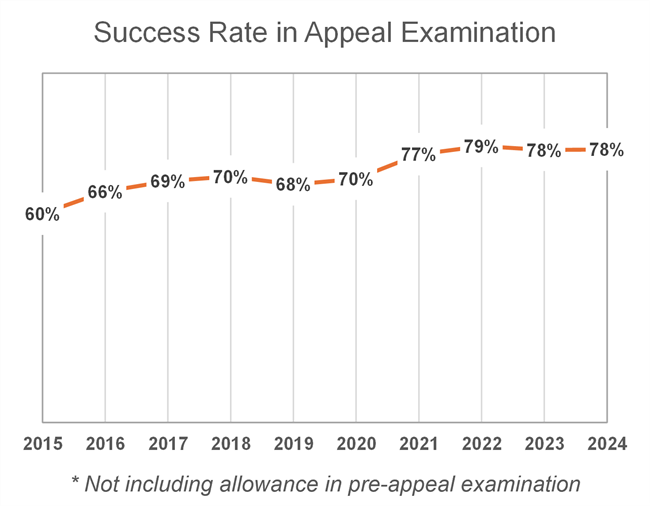
According to JPO statistics, the success rate of appeals against Decisions of Rejection has been increasing year by year, reaching 78% in 2024. Therefore, even if you receive a Decision of Rejection, there is no need to give up immediately. In the author’s experience, it is often easier to obtain a patent at the appeal stage than at the examination stage, particularly with regard to inventive step.
2. Success Rate of Appeals Without Amendments
If an applicant files an appeal without amendments, the claims remain unchanged, and the applicant must present direct arguments that the Decision of Rejection was improper. By analyzing the outcomes of such appeals, we can see the “reversal rate” more directly.
The author analyzed patent applications for which appeals without amendments were filed between 2015 and 2024 and Appeal Decisions were issued in 2024. Cases were classified into three categories: (1) immediate allowance without further Office Action, (2) Office Action(s) issued during appeal examination, and (3) immediate rejection without further Office Action.
The results are as follows.
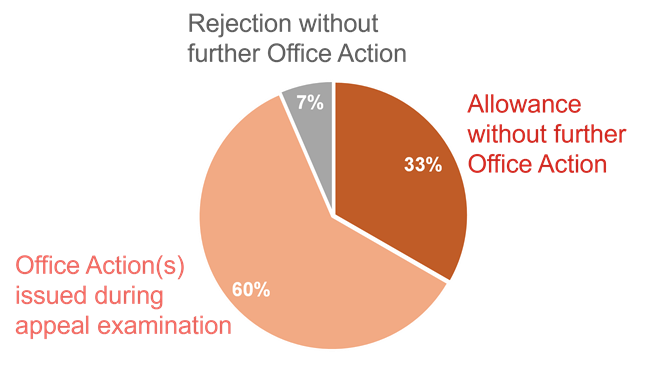
In about one-third (33%) of cases, the Appeal Board issued an Appeal Decision of Allowance without issuing any further Office Action, i.e. overturning the Decision of Rejection. In addition, in about 60% of cases, the Appeal Board issued one or more Office Actions during the appeal examination before issuing an Appeal Decision. Such Office Actions usually include new reasons for rejection that were not raised until a Decision of Rejection.
In the author’s experience, the Appeal Board tends to be more flexible and applicant-friendly than Examiners in the examination stage. For example, the Appeal Board often issues an Office Action to provide the applicant with an opportunity to make amendments, or even suggests specific amendments that would make the invention patentable.
For these reasons, we recommend proactively considering filing an appeal when you receive a Decision of Rejection on an important application.
| For updates on new practical tips and upcoming webinars, please follow our official LinkedIn page, where we regularly share insights on Japanese IP practice. |