Brief Summary
|
The overview of the judgment flowchart of inventive step in Japan is as follows:
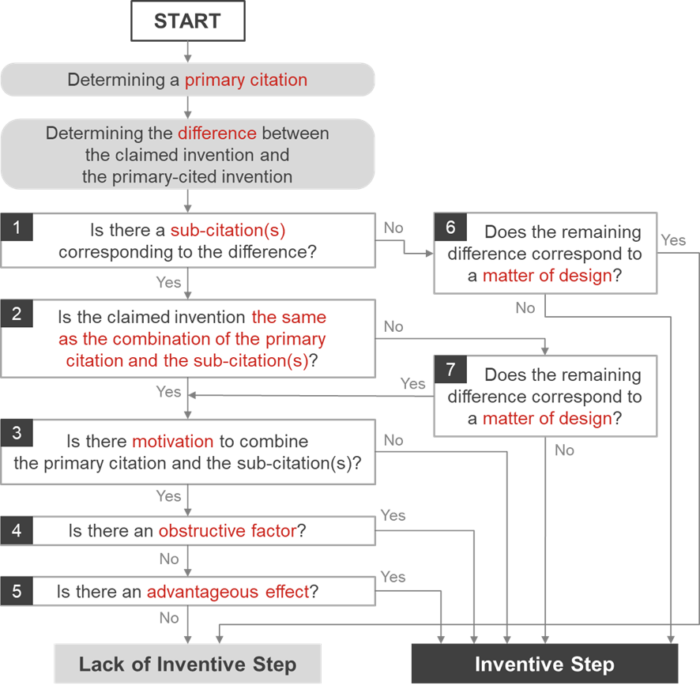
The Examiner first searches for a primary citation, which corresponds to the closest prior art in the EP examination, and determines the difference between the claimed invention and the primary-cited invention disclosed in the primary citation.
Then, the Examiner searches for a sub-citation(s) to complement the difference.
The flowchart includes 3 routes depending on Questions 1 and 2.
[Route 1] Questions 1 and 2: both “Yes”
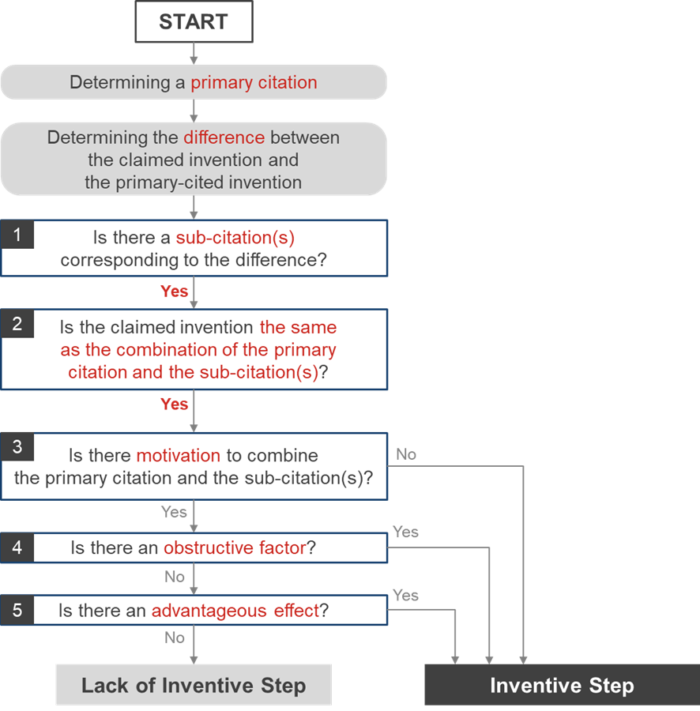
In Route 1, the inventive step is judged by the presence/absence of:
- motivation to combine the primary citation and the sub-citation(s) (Question 3);
- an obstructive factor against conceiving the claimed invention starting from the primary citation (Question 4); and
- an unexpected advantageous effect of the claimed invention (Question 5).
In order to deny inventive step, the Examiner has to show the presence of motivation to combine the primary citation and the sub-citation(s).
[Route 2] Question 1: No
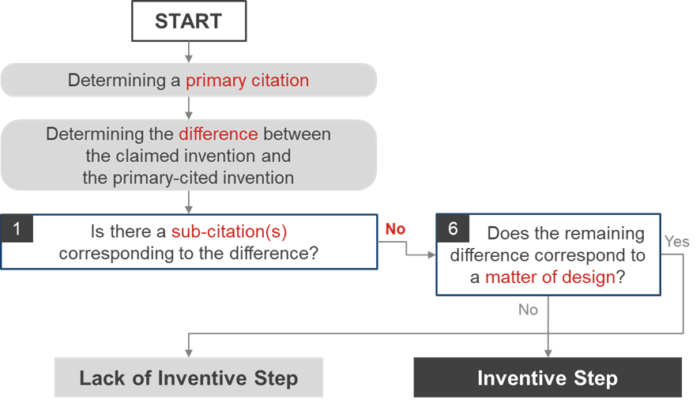
In Route 2, the Examiner judges whether the difference is just a matter of design which a skilled person could have appropriately made (Question 6).
The Examiner does not necessarily show evidence for the matter of design.
[Route 3] Question 1: Yes, Question 2: No
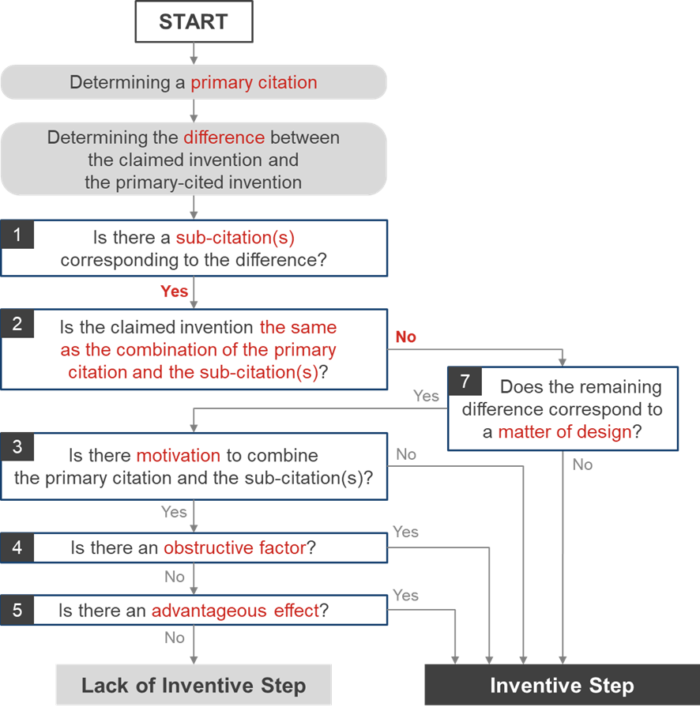
Route 3 is the combination of Route 1 and Route 2: there is a remaining difference after combining the primary citation and the sub-citation(s).
The Examiner first judges whether the remaining difference is just a matter of design (Question 7).
If the answer is No, the Examiner judges that the claimed invention has inventive step.
If the answer is Yes, the Examiner then judges motivation (Question 3), an obstructive factor (Question 4), and an unexpected advantageous effect (Question 5) as in Route 1.
Details for each factor will be covered in separate articles.
| For updates on new practical tips and upcoming webinars, please follow our official LinkedIn page, where we regularly share insights on Japanese IP practice. |