Brief Summary
|
1. Four factors of motivation
In the flowchart of inventive step in Japan, motivation is related to Question 3.
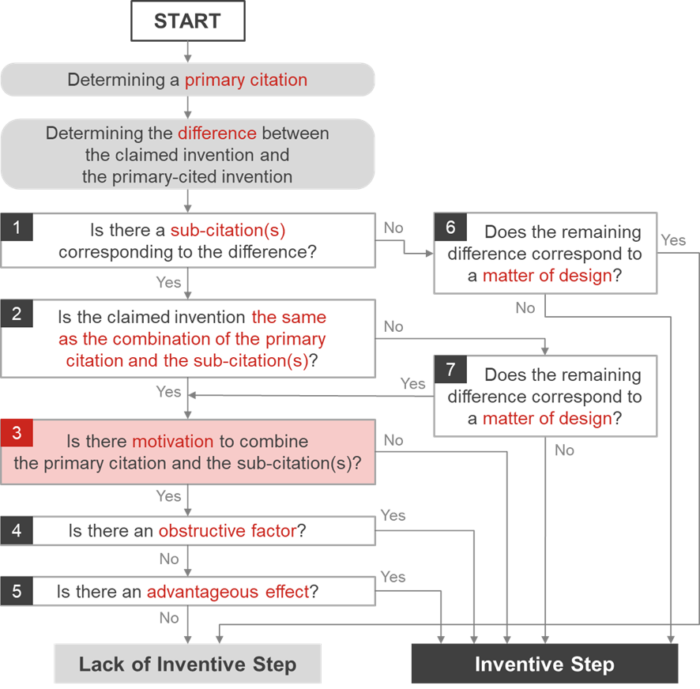
In JPO examination, motivation is determined by comprehensively considering the following factors:
- Relation of technical fields
- Similarity of problems to be solved
- Similarity of operations or functions
- Suggestions shown in the content of prior art
For example, the following example is given:
|
[Example] |
If the technical fields F1 and F2 are close to each other, the Examiner thinks that a skilled person is motivated to apply the sub-cited invention to the primary-cited invention since they belong to the close technical fields F1 and F2, respectively (factor 1).
Also, if the problems P1 and P2 are similar to each other, the Examiner thinks that a skilled person is motivated to replace the constitution “C” of the primary-cited invention with the constitution “B” of sub-cited invention since they can solve the similar problems P1 and P2, respectively (factor 2).
The same applies if the operation or function of the primary-cited invention is similar to that of the sub-cited invention (factor 3).
Finally, if the suggestion to combine the primary citation and the sub-citation(s) is found in the prior art, it is a strong motivation (factor 4).
2. How to think of these factors of the claimed invention
The Examiner usually compares the technical field, problem, and operation/function between the primary citation and the sub-citation.
However, if the technical field of the claimed invention is far from, or the problem of the claimed invention is quite different from, those of the citations, it weakens the motivation to reach the claimed invention starting from the primary citation.
Accordingly, it can be effective to describe a unique and non-obvious problem, which is different from those of prior art, in the specification.
| For updates on new practical tips and upcoming webinars, please follow our official LinkedIn page, where we regularly share insights on Japanese IP practice. |