Introduction
While court decisions regarding the similarity of designs are fairly common, it seems that decisions made by the Japan Patent Office (JPO) are rarely introduced. However, trial examinations are handled by a group of three Appeal/Trial Examiners, and these decisions often provide detailed comparisons of designs and systematic explanations, offering highly practical insights.
This time, we will introduce a similarity judgement of designs related to a common household item: a frying pan. The applied-for design claims the body and handle of a frying pan (the joint is disclaimed). In contrast, a frying pan featured on another company’s website was cited. Are these two designs similar?
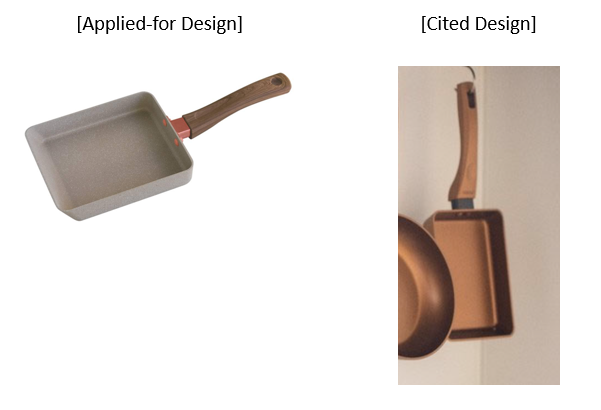
For more detailed photographs, please see refer to the following page.
Overview of the case
Type of Decision: Decision in Appeal against Decision of Rejection
Case Number : Appeal No. 2024-13188
Judges: JPO Appeal/Trial Examiners
Article for which the Design is applied: Frying Pan
Conclusion: The original decision is overturned. The design of this application shall be registered. (Dissimilar to the cited design)
Personal Criteria: Demanders* * This refers to relevant consumers and traders.
Publicly Known Designs: Considered
Cited Design: The part of the square frying pan – featured on the Corelle Brands website on July 1, 2021 – that corresponds to the part claimed in the applied-for design.
Summary of Reasons for Decision
Comparison of the Two Designs
[The article]
It is a “Frying Pan”, which is common to both designs.
[The use and function of both claimed parts]
It is “frying pan body and handle”, which is common to both claimed parts.
[Position, size and scope of both claimed parts within the design as a whole]
The position and scope are common to both the frying pan body and the handle (excluding the neck portion between the two parts). The size, based on the overall ratio of the width in a front view, is common to both designs at a ratio of frying pan body : overall = 1 : 2. The ratio of the handle : overall is 1 : 2.3 in the present design and 1 : 2 in the cited design, so they are almost identical.
[Shape and other characteristics* of both claimed parts]
* This refers to “shape, pattern or color, or any combination thereof”.
The common points are:
(A) The frying pan body is shaped like a shallow pot, and in a front view it is a roughly elongated rectangle with rounded corners. The front wall is inclined relative to the bottom surface, the side and back walls are roughly perpendicular, the thickness of each wall is roughly uniform, and a roughly rod-shaped handle is positioned near the upper edge of the back wall. In the bottom view, this handle curves from the left end to the right end in a downward arc, slightly curving upwards to the right.
(B) In a bottom view, the ratio of the width to depth of the frying pan body is approximately 1:0.2.
(C) In the front view, the handle is a roughly elongated rectangle, with the top and bottom edges slightly curved inward so that it is narrowest slightly to the left of the center in the longitudinal direction. A hole is provided near the center of the right end, and there is a slight indentation near the center of the front side near the left end.
The different points are:
(a) The handle portion in a front view: the cited design has a chamfer along the longitudinal direction, but the present application does not.
(b) The handle portion in a rear view: the present application has one large and one small roughly bullet-shaped indentation with their points facing each other, whereas the shape of the inscribed design is unclear.
(c) The frying pan body and handle portion: in the present application the body is a stone marble-like gray and the handle portion is a wood grain-like brown, whereas in the cited design both parts are plain gold.
Judgment of Similarity
The demanders of frying pans are mainly users (including buyers) and traders such as retailers. They observe the pan-shaped body and the handle that comes into contact with the hand, as well as the overall appearance, including how it looks when placed on a heating device or as a decorative item in the kitchen. Therefore, in evaluating the shape of both designs, similar points and differences are evaluated based on the same perspective.
In both designs, the articles are identical, and the use and function as well as the position, size and scope of both claimed parts are also identical.
With respect to the shapes and other characteristics of both claimed parts, Common point (A) concerning the overall shape is the basic shape of a frying pan, but it is a feature that consumers will notice, and therefore it has a certain degree of influence on the judgment of similarity. Common point (B) is common in the field of pots and pans, where products are generally offered in various sizes, so its influence on the judgment of similarity is limited. The shape related to Common point (C) was publicly known in the field of this type of article even before the filing of this application (Reference examples), and it cannot be said to be unique to this application; therefore, it does not particularly attract the attention of consumers, and its influence on the judgment of similarity is small.
Difference (a) concerns the details of the handle, but it gives consumers a distinct aesthetic sense when cooking or displaying the product, so it has a significant influence on the judgment of similarity. Difference (b) concerns the back side of the handle, but it is the part where fingers rest during use, and it can be said to have a certain degree of influence on cooking, and therefore it has a certain degree of influence on the judgment of similarity. Difference (c) is evident in the overall appearance of both parts and is a point that attracts consumer attention. However, since the pattern and color of the present application are commonplace, its influence on the similarity judgment is considered to be only to a certain extent.
Based on the evaluation of the common points and differences, a comprehensive observation of both parts reveals that the influence of common points is a certain degree or limited/small, while the influence of differences is large or a certain degree. Therefore, the shapes and other characteristics of the two claimed parts cannot be said to be similar.
Both designs are identical in terms of the article, the use and function of both claimed parts, and the position, size and scope of both claimed parts, but the shapes and other characteristics of the two claimed parts are not similar.
Therefore, the two designs are dissimilar.
Shiga’s comment
As seen in the decision mentioned above, when determining the similarity of a “Partial Design” (a design containing disclaimed parts), the four elements of the two designs are first compared. After identifying the commonalities and differences regarding each element, the impact they have on the similarity judgement is evaluated. If the cumulative impact of the commonalities is greater, the designs are deemed “similar”; conversely, if the cumulative impact of the differences is greater, they are deemed “dissimilar”.
In the case mentioned above, the assessment that the impact of the differences regarding the shape and other characteristics of the claimed parts (i.e. the fourth element) outweighed the impact of the commonalities led to the final conclusion “The two designs are dissimilar”.