Judgments on inventive step have always been a key issue in lawsuits against the JPO’s trial decisions. Statistically, the Intellectual Property High Court (IPHC) tends to maintain the Japanese Patent Office (JPO) trial decision in terms of inventive step. That said, there are some cases in which the IPHC has revoked JPO trial decisions, playing a key role in the execution of Japanese Patent Law. In particular, the obviousness of differences has been a controversial issue when the IPHC examines inventive step.
This article introduces a case when the IPHC denied the argument of the plaintiff regarding the logical justification of “Obviousness Based on Step-by-Step Modification”.
Among the controversial issue, if either the obviousness of combining the primary reference with the first reference or the obviousness of combining the first reference with the second reference is difficult to achieve, then the present invention may be deemed to have inventive step (non-obviousness) on the grounds that it is difficult to achieve obviousness from a combination of the primary reference, the first reference, and the second reference. Such cases are sometimes described as “not easy to conceive.” The fact that an invention that is “easily conceived” is considered to have inventive step is merely a tendency in examination practice and is not explicitly stated in the JPO (Japanese Patent Office) Examination Guidelines as a circumstance that affirms inventive step.
In this case, the plaintiff (the patent holder) argued that this judgment falls under the “obviousness based on step-by-step modification” framework and therefore the invention should not be regarded as obvious—that is, the invention should be recognized as having an inventive step. However, the Intellectual Property High Court (IPHC) rejected this JPO decision.
Overview of the case
Case number: 2024 (Gyo-ke) No. 10099
Type of Case: Request for revocation of patent revocation decision
Judgment: The IPHC rendered the decision that the Plaintiff’s claim be dismissed on November 13, 2025.
Title of Invention of the Patent in Question: Information Network System Equipped with a Massage Machine
Japanese Patent Registration Number: 7101394
Issue:
The plaintiff is the patent holder of the aforementioned invention. Following the patent opposition (Opposition No. 2023-700017) decision issued by the JPO, the plaintiff filed a request for correction, including the deletion of Claims 2 and 3. While the JPO approved the corrections, they revoked the Patent relating to Claims 1, and 4-9. In response to the JPO decision, the Plaintiff brought an action seeking to set aside the portion of the JPO decision that revoked the patent.
Plaintiff’s Arguments
The Plaintiff argued that, a) the terminal device 104 in Invention of Exhibit A2-1 is an “external device” and not “attached to the massage machine” as in Amended Invention 1, and therefore integrating the terminal device into the massage machine would cause the essential technical feature of Exhibit A2 to be lost, and thus integration would not be easily conceivable.
Furthermore, in addition to a), procedure b) of configuring the massage machine (microcontroller 130) to download information would require a two-step process of “integrating and replacing.” Therefore, performing b) in addition to a) would fall under a prima facie case of “obviousness,” and could not be considered easy to achieve.
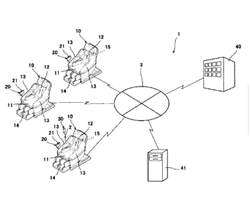
[Present Invention]
[Invention of Exhibition A2-1 (Document of Exhibition A2-1 (WO2014/196922, PCT/SG2013/000232)]
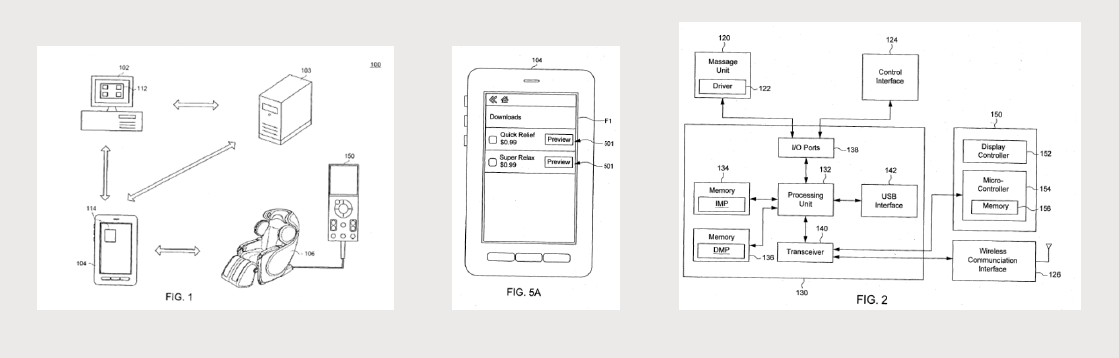
Summary of the Judgment
The IPHC found that there are similarities and differences between the plaintiff’s Amended Invention 1 and Invention 1 of Exhibit 2.
The similar points are that they are information network systems consisting of a massage machine having a treatment unit that provides treatment to the person being treated, a control unit that controls the treatment unit, and an operating device installed to operate the treatment unit via the control unit, and a communication server managed by the business operator that manages the massage machine. The information network system is configured such that, in order for the person being treated to operate the massage machine while seated before the data for the new treatment course is downloaded from the communication server, a new notification unit on a terminal device installed outside the massage machine notifies the person, and once the introduction of the new treatment course is decided on the terminal device, the data for the new treatment course is downloaded from the communication server and introduced.
The main points of Differences, 1) to 3), are as follows:
1) A difference lies in whether the purchase transaction involves a remote controller attached to the outside of the treatment unit, or a terminal device located away from the treatment unit.
2) The control unit can directly download updated information from the communication server without going through other terminal devices, or the information can be displayed on an external terminal device, displayed as an image frame on the user’s device, and when a transaction is made to purchase a selected massage program, the downloaded content is transferred to the massage device.
3) A difference lies in whether or not the treatment data to be updated has been identified.
The IPHC’s Decision
After listing the similarities and differences, it is obvious that, where a person skilled in the art, by exercising ordinary creative ability to simplify and improve a system, arrives at a configuration in which data is downloaded directly without the use of a terminal, it is necessary to make substitutions to assign functions such as display functions.
When there are limited reasonable options for this, it is only natural that a person skilled in art would choose those option without exercising further creative ability.
The IPHC decided that, where the method of improvement itself is self-evident, the case should not be assessed by dividing the analysis into 1) and 2) mentioned above, and characterizing it as the so-called ”obviousness based on step-by-step modification.” Therefore, the patentee’s argument that the case should be evaluated under the “obviousness based on step-by-step modification” framework cannot be accepted.