Introduction
While court decisions regarding the similarity of designs are fairly common, it seems that decisions made by the Japan Patent Office (JPO) are rarely introduced. However, trial examinations are handled by a group of three Appeal/Trial Examiners, and these decisions often provide detailed comparisons of designs and systematic explanations, offering highly practical insights.
This time, we will introduce a judgement of similarity between designs for “Handrail” and “Fence”. Although the names of the articles (the titles of the designs) differ, are these articles similar? In addition, for articles of this type, which specific parts – in terms of their shape or other characteristics – are given particular attention when determining whether similarity or dissimilarity?
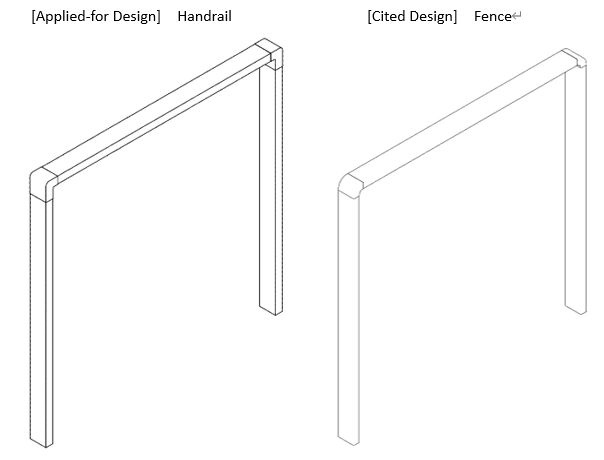
For more drawings, please refer to the following page.
figures of applied-for design, cited design, and reference designs
Overview of the case
Type of Decision: Decision in Appeal against Decision of Rejection
Case Number : Appeal No. 2025-5215
Judges: JPO Appeal/Trial Examiners (3 members)
Article for which the Design is applied: Handrail
Conclusion: The original decision is overturned. The design of this application shall be registered. (Dissimilar to the cited design)
Personal Criteria: Demanders* * This refers to relevant consumers and traders.
Publicly Known Designs: Considered
Applied-for Design: App. No. 2023-26085 “Handrail” design
Cited Design: Reg. No. 1610494 “Fence” design
Summary of Reasons for Decision
Comparison of the Two Designs
[Article]
The article for the applied-for design is a “Handrail”, while the article for the cited design is a “Fence” which is also used as a handrail*. Although the terms used differ, both are employed as handrails, so they share the same purpose and function.
* Author’s note: This is explained in its application documents.
[Shape and other characteristics*]
* This refers to “shape, pattern or color, or any combination thereof”.
The common points are:
(A) The basic configuration consists of a generally rectangular tubular structure bent – when viewed from the front – into an inverted, roughly U-shaped form with rounded corners. It comprises a pair of uprights, a horizontal member, and two connecting components that join them.
(B) The length ratio of the uprights to the horizontal member is approximately 1:1, and the ratio of the long side to the short side of the cross-section is approximately 2.5:1.
(C) On the horizontal member, when viewed from the bottom, an elongated plate (panel strip) is formed in the center, extending across the entire width.
The different points are:
(a) Overall, the applied-for design has sharp, angular features, whereas the cited design has rounded corners.
(b) Regarding the horizontal member, when viewed from the bottom, the plate in the applied-for design has a longitudinal width (depth) that is approximately 30% of its total width, and there are a total of eight small, dome-shaped screw heads at both ends; in contrast, the plate in the cited design has a longitudinal width that is approximately 70% of its total width, and no screw heads are present.
(c) Regarding the connecting components, the applied-for design is bent into a generally L-shape with the outer corner rounded into an arc, whereas the cited design features a generally fan-like, curved shape.
Judgment of Similarity
[Article]
The articles of both designs are identical because they share the same purpose and function.
[Evaluation of Common points and Different points in Shape and other characteristics]
Evaluation of Common points
Regarding Common point (A), the basic structural configuration – a generally rectangular tubular structure bent into an inverted U-shape – is publicly known (Reference Design 1). Since this feature is not unique to the two designs, it does not particularly attract the attention of demanders; therefore, this common point has little impact on the judgement of similarity.
Regarding Common point (B), the length ratio between the uprights and the horizontal member (approximately 1:1) is found in Reference Design 2, while the length ratio between the long and short sides of the cross-section (approximately 2.5:1) is found in Reference Design 1. Since these features are not unique to the two designs and do not attract the attention of demanders, this common point has little impact on the judgement of similarity.
Regarding similarity (C), the configuration in which an elongated plate (panel strip) is formed across the entire width of the bottom surface of the horizontal member is publicly known (Reference Design 1). Since this feature is not unique to the two designs, it does not attract the attention of demanders; therefore, this common point has little impact on the judgement of similarity.
Evaluation of Different points
Regarding Different point (a), the applied-for design conveys a sharp, taut impression with well-defined edges, whereas the cited design conveys a gentle, rounded impression. Given that the horizontal member – the part most likely to be touched by a user and the most visually prominent – is where demanders focus their attention, Different point (a) has a significant impact on the judgement of similarity.
Regarding Different point (b), the bottom surface of the horizontal member is rarely visible once the article is installed; therefore, this different point has little impact on the judgment of similarity.
Regarding Different point (c), the connecting member in the applied-for design is bent into a generally L-shaped configuration, which creates a rigid, angular impression. In contrast, the member in the cited design is a generally fan-shaped, curved tubular structure, which creates a soft, rounded impression. In combination with Different point (a), this evokes a different aesthetic impression in the demander; therefore, Different point (c) has a significant impact on the judgement of similarity.
[Judgement of Similarity in Shape and other characteristics]
Based on an evaluation of the common points and the different points, and upon observing the designs as a whole, it is determined that Common points (A) through (C) have only a minor impact on the judgment of similarity. Conversely, while Different point (b) has a minimal impact, Different points (a) and (c) have a significant impact.
Consequently, since the different points between the two designs carry more weight than the common points, the designs are not similar.
Conclusion
Although both designs relate to the same type of article, they are not similar in their shape and other characteristics. The applied-for design is dissimilar to the cited design.
Shiga’s comment
When assessing the similarity of standard designs (i.e., those that do not contain disclaimed part and are not so-called “partial designs”), two elements are compared: the “article” and the “shape, pattern or color, or any combination thereof”. Regarding the “article”, the assessment is not based solely on its name; rather, its intended use and function are compared to determine whether it is identical/similar or dissimilar.
As for the “shape, pattern or color, or any combination thereof” (“Shape and other characteristics” in this article), the common and different points between the two designs are carefully identified, and the relative weight of each point – in terms of its impact on the judgment of similarity – is evaluated. Generally, common or different points concerning the basic structural configuration carry significant weight; however, this does not apply if such features are commonly found in publicly known designs. In addition, common or different points located in areas that typically attract the attention of demanders are often considered to have a greater impact.
In the case mentioned above, it was determined that the combined impact of all the different points in the “shape, pattern or color, or any combination thereof” of the two designs outweighed the combined impact of all their common points; consequently, the applied-for design was judged to be dissimilar to the cited design.