|
Two post-grant procedures are available before the JPO to a third party who wishes to challenge a granted Japanese patent: the Opposition and the Invalidation Trial.
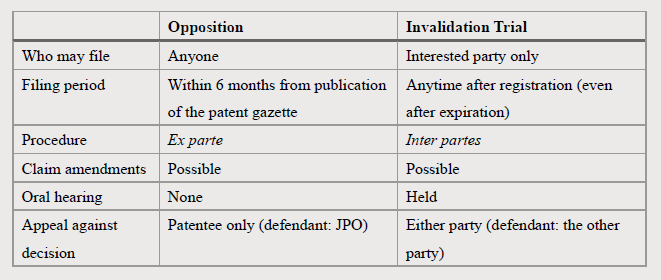
Although both procedures may lead to revocation of the patent, they differ in several important respects. The principal differences are set out below.
1. The Opposition structurally favors the patentee
An Opposition is, in substance, an ex parte re-examination of the patent by the JPO rather than a contest between the parties. No oral hearing is held, and only the patentee may hold an interview with the JPO’s Opposition Board. When the JPO decides to maintain the patent, the opponent has no right of appeal.
The procedure therefore tends to favor the patentee.
The opponent must also present all reasons for revocation and all supporting evidence by the statutory deadline. After that deadline, new reasons for revocation cannot be added, and the evidence cannot be replaced or supplemented. Thorough preparation before filing is therefore essential.
Despite these constraints, the Opposition offers real practical advantages: a lower fee than the Invalidation Trial; the option to file through a nominee, so that the identity of the party truly behind the challenge need not be disclosed; and an early, low-commitment opportunity to challenge a competitor’s obstructive patent soon after grant.
It is accordingly best suited to a prompt, cost-efficient challenge, particularly against a patent of limited strategic importance, or where the challenger prefers to remain anonymous.
2. The Invalidation Trial resolves disputes between parties
The Invalidation Trial is designed as a dispute resolution mechanism between the parties.
It is an inter partes proceeding in which an oral hearing is held and the demandant may participate actively in the JPO’s trial procedure.
Both parties may appeal the decision to the IP High Court.
Since direct argument against the patentee is possible and appeal rights are symmetrical, the Invalidation Trial is the preferred route for invalidating a commercially significant patent.
The Invalidation Trial is often used as a countermeasure against infringement litigation.
The trade-offs are a higher fee, a longer and more formal process, and the requirement that the demandant be an interested party.

| We send newsletters and webinar invitations by email periodically. If you would like to receive this information, please subscribe by completing the form, or follow our official LinkedIn page. |