Claim drafting often determines a claim’s patent enforceability and therefore, satisfying description requirements, clarity in particular, is key to securing its enforcement. This article introduces a current patent dispute which moved from JPO (Japanese Patent Office) examination (prosecution), to opposition, and finally to infringement litigation. Interestingly, the Court overturned the JPO decision to grant a patent due to failure to satisfy the clarity requirements while clarity had not been raised before the JPO.
Overview of the Case
Case Number: 2024(Wa)70064
Type of Case: Infringement litigation
Judgment: The Tokyo District Court handed down a decision stating that the Patentee’s claim does not satisfy the clarity requirements.
Subject Patent: JP 7026270
Patentee (Plaintiff): Dainihon Jochugiku Company, Limited (known as “KINCHO”)
Title of Invention: AEROSOL FOR MOSQUITO CONTROL AND MOSQUITO CONTROL METHOD
Defendant: Earth Corporation
KINCHO filed a lawsuit against Earth Corporation on March 1, 2024, alleging that Earth infringed KINCHO’s patent. Both are major Japanese companies which offer their products of household insecticides, household cleaning products, etc. Therefore, gaining a competitive edge through patent obtainment is indispensable.

Patent at Issue
The present invention is related to a mosquito control aerosol that maintains strong effectiveness for a long period, while reducing influence on humans and pets. By increasing the effect of controlling mosquitoes sitting on a wall surface, the control of all mosquitoes entering a house can be improved. … In order to achieve this, at least a portion of the aerosol-forming liquid sprayed into the treatment space is in the form of adhesive particles which adhere to an exposed portion in the treatment space. In this way, mosquitoes sitting on the exposed portion and mosquitoes flying in the treatment space can both be effectively knocked down or killed.
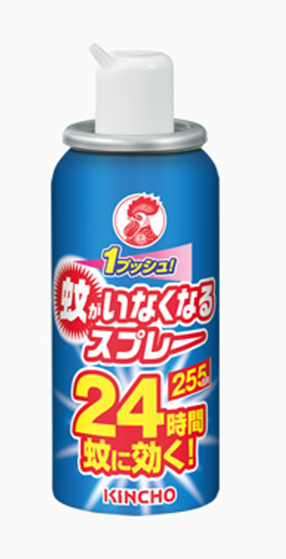
KINCHO INAKUNARU One-push Aerosol Mosquito Insecticide Spray
The following are excerpts from the specification.
Object of invention
[0011]
With the above problems in mind, the present invention has been made. It is an object of the present invention to provide a mosquito control aerosol which can maintain the effect of significantly controlling flying insect pests, particularly mosquitoes, for long periods of time while reducing the influence on humans and pets, and a mosquito control method using the mosquito control aerosol.
[Claim 1]
*red parts are added for novelty and inventive step, green parts are added for support requirements.
A mosquito control aerosol comprising: a pressure-resistant container (…) and a spray button (…),
wherein said insect pest control component is metofluthrin and/or transfluthrin,
wherein said aerosol-forming liquid includes the insect pest control component in an amount of 14.3 wt% or more,
wherein the volume of the aerosol-forming liquid sprayed when the spray button is pressed down once is adjusted to 0.1 to 0.4 mL,
wherein the spray force as measured at a distance of 20 cm from the spray outlet at 25℃ is adjusted to 0.3 to 10.0 g・f,
wherein at least a portion of the liquid aerosol-forming material is sprayed from the spray outlet in the form of adhesive particles which adhere to an exposed portion in a treatment space,
wherein an amount of the insect pest control component by one spray is adjusted to 5.0 to 30 mg per 4.5 to 8 Jyos (“Jyo” is a Japanese unit of area: about 18.5 to 33.0 m3)
(excluding mosquito control aerosols that are attached to a main unit of an automatic sprayer).
Main concept of invention
[0013]
Incidentally, the present inventors’ study has found that, (…), the period of time when the insect is sitting on a wall surface, etc. is longer than the period of time when the insect is flying.
In other words, most of the mosquitoes which have entered a house are sitting on a wall surface etc. to wait for a chance to suck blood from a human.
(…) The present inventors have conceived (…) that, by increasing the effect of controlling mosquitoes sitting on a wall surface etc., the control of all mosquitoes entering a house can be improved while reducing inhalation of the chemical by a human or pet.
…
Therefore, in the mosquito control aerosol of the present invention, at least a portion of the aerosol-forming liquid sprayed into the treatment space is in the form of adhesive particles which adhere to an exposed portion in the treatment space (…).
Therefore, mosquitoes sitting on the exposed portion and mosquitoes flying in the treatment space can both be effectively knocked down or killed, whereby the effect of controlling all mosquitoes can be improved.
…
Also, even if particles other than the adhesive particles (referred to as “suspendable particles”) diffuse throughout the treatment space, the concentration of the aerosol-forming liquid in the treatment space is reduced by an amount corresponding to the amount of the adhesive particles.
Therefore, the amount of the liquid aerosol-forming material particles inhaled by a human or pet in the treatment space is considerably small, and therefore, the mosquito control aerosol is safer for humans and pets.
Compared with conventional products, two types of adhesive particles in the present invention work effectively to kill or knock down mosquitoes. Below shows a comparison between conventional products and the present invention.
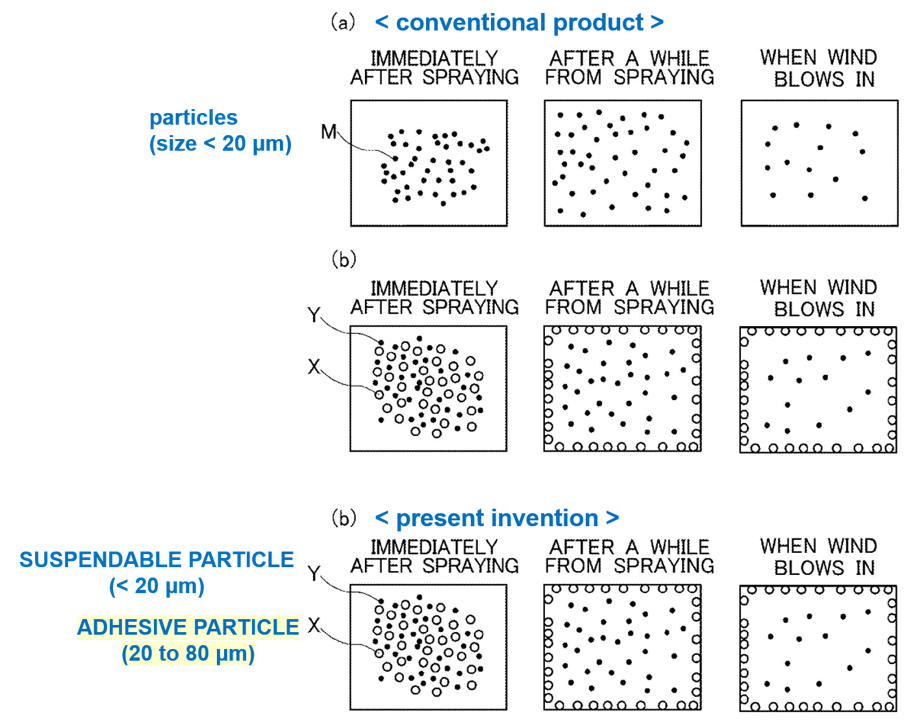
Conventional products use fine particles of smaller than 20 µm. Conventional fine particles may not effectively kill mosquitoes resting on walls. Wind may reduce the effect. Also, particles remaining in the air may increase inhalation risk.
The present invention includes two kinds of particles, they are, adhesive particles X of 20 to 80 µm, and suspendable particles Y of smaller than 20 µm. Relatively large adhesive particles stay on surfaces, and relatively small suspendable particles spread in the air.
According to the present invention, mosquitoes sitting on the exposed portion can be knocked down or killed by the adhesive particles X. The adhesive particles X continue to be present on the exposed portion even if wind blows into the treatment space. Also, the influence of inhalation of the suspendable particles Y is reduced, and therefore safer.
JPO Examination
KINCHO filed the patent application on March 2, 2021, as a divisional application under the Accelerated Examination. The first Office Action raised novelty, inventive step, and support issues. After having an Interview with the Examiner, Amendments and Remarks were filed. A third party observation was then filed. However, the Examiner did not issue another Notice of Reasons for Rejection, and issued a Decision of Allowance on December 21, 2021.
JPO Opposition
After the patent was published in February 2022, an Opposition was filed in August 2022. The Opponent was a strawman. In the present case, the opponent raised three grounds for opposition; novelty based on public use (Ground 1); novelty based on publications (Ground 2); inventive step based on multiple references (Ground 3)
The JPO Opposition Board accepted some of the evidence, such as website and newspaper articles. However, they rejected the other evidence. For example, later submitted photos and measurement reports were considered insufficiently reliable. Specifically, the JPO indicated that “The photos are taken after the priority date and because it is not a natural assumption that the descriptions in the photos are the contents of the product according to the website” and that:
“It is unclear (i) when the measurement was done, (ii) how the sample was acquired, and (iii) the relationship between the measured sample and the product according to the website.”
This shows that proving public use (Ground 1) is quite difficult in Japan.
Finally, the Opposition board concluded that claims 1 to 12 could not be revoked. It also confirmed that no other reason for revoking the patent is found. So, the patent survived opposition.
Battle in Court
Earth (Defendant) argued many invalidity grounds: clarity, support, enablement, novelty, and inventive step. The disputed term was “adhesive particles”. The Court indicated that the term, “adhesive particles”, is not obvious from the recitations of the claims and interpreted as follows:
“Adhesive particles” can be defined as chemical particles formed when a liquid aerosol-forming material is sprayed into a treatment area, where these particles adhere to exposed surfaces within the treatment area, remain adhered over time, and serve to exterminate or repel mosquitoes that land on those surfaces.
The Court further stated that, in order to say “remain adhered over time, and serve to exterminate or repel mosquitoes that land on those surfaces”, it is not sufficient for the particles to simply adhere to the surface; rather, the degree of adhesion must be clearly defined so that it can be said to “remain adhered over time”. However, there is no description about how to measure the degree of adhesion. Thus, even referring to the specification, the meaning of “adhesive particles” cannot be understood.
Our analysis
In this case, the patent survived examination and opposition, but was found invalid in Court. In addition, clarity had never been an issue at the JPO (examination and opposition), but suddenly became an issue in patent litigation. This court case gives us practical lessons for patent drafting and enforcement in Japan. Applicants should be mindful of terms of relative character (“adhesive”, “hard”, etc.) recited in claims. Claim 1 includes “adhesive particles,” which is interpreted as a language of a functional claim. The specification describes neither the degree of adhesion clearly nor how to measure the degree of adhesion. Although a functional claim is useful to make a broad scope of protection, it may make the claim ambiguous. When drafting such claims, the specification/claims should describe technical characteristics in detail to avoid failure to satisfy description requirements.
Case History
2021/7/6 Request for Accelerated Examination
2021/8/17 First Office Action (Novelty, Inventive Step, Support Requirements)
2021/9/30 Interview with Examiner
2021/10/5 Amendments and Remarks
2021/12/9 Third Party Observation
2021/12/21 Decision of Allowance
2022/2/25 Patent Gazette was published
2022/8/25 Opposition was filed (under the name of a strawman)
2022/11/21 Opposition Decision to Maintain the Patent (without claim corrections (amendments))
2024/3/1 KINCHO filed a lawsuit against Earth Corporation at the Tokyo District Court
2025/12/17 District Court Decision (without requesting an Invalidation Trial)