|
1. Three Requirements Applied in Stages
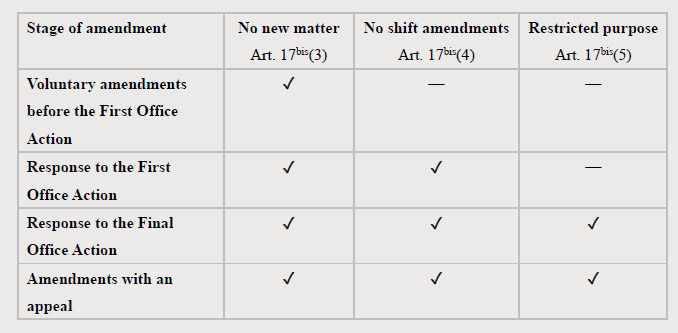
The requirements for amendments become stricter as examination progresses.
The prohibition of new matter applies to every amendment.
The prohibition of shift amendments, which requires the amended claims to maintain unity of invention with the claims already examined, applies once an Office Action has been issued.
The restriction on the purpose of amendments applies only to responses to a Final Office Action and to amendments filed with an appeal against a Decision of Rejection.
Table 1: Requirements applicable at each stage
2. Restricted Purpose
Under Article 17bis(5), amendments in response to a Final Office Action, or filed with an appeal against a Decision of Rejection, must fall within one of the four purposes shown in Table 2.
The rationale for this restriction is that the Examiner should not be required to conduct a new examination beyond the scope that has already been examined.
Table 2: Permitted purposes under Article 17bis(5)
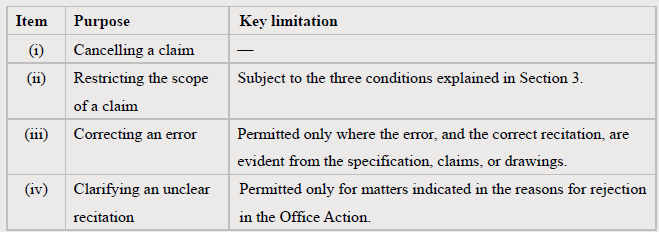
Typically, cancellation, correction, and clarification do not change the substance of the claimed invention.
Consequently, the restriction of claim scope is usually the only purpose through which an applicant can overcome a rejection based on prior art, and it is therefore explained in more detail below.
3. Restriction of Claim Scope
Most violations of the purpose restriction concern the restriction of claim scope. A permitted restriction must satisfy three conditions:
- The amendments must narrow the scope of the claim.
- The amendments must limit a matter that already specifies the invention. Adding a new specifying matter is not permitted, even if it is supported by the specification.
- The field of industrial application and the technical problem must remain the same.
Table 3: Typical examples
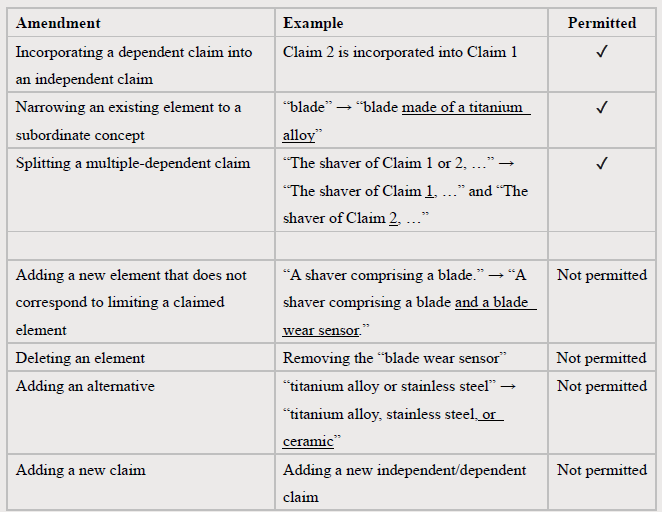
Whether particular amendments satisfy these conditions often depends on the wording of the claims. If you are uncertain whether proposed amendments are permissible, please do not hesitate to consult us before the response is filed.
4. Consequences and Practical Recommendations
If amendments in response to the Final Office Action do not meet these requirements, the Examiner will dismiss the amendments and the claims will then revert to their form before the amendments.
In that case, because the reasons for rejection in the Final Office Action still apply, a Decision of Rejection will be issued.
We therefore recommend keeping dependent claims that provide meaningful fallback positions before a Final Office Action is issued. Incorporating such a dependent claim into the independent claim is the most reliable way to amend at this stage.
If broader or different protection is needed, the applicant should consider filing a divisional application within the period for responding to the Final Office Action.

| We send newsletters and webinar invitations by email periodically. If you would like to receive this information, please subscribe by completing the form, or follow our official LinkedIn page. |