|
1. What the numbers cover
Foreign applicants frequently face a strategic choice: amend the claims, or maintain them and counterargue.
To inform that choice, cases for which the JPO made decisions during 2024 were analyzed. The study isolated 2,627 applications in which applicants responded to the first Office Action without any amendments, and in which no amendment was entered before the final decision.
To measure each rejection cleanly, only applications for which a single reason for rejection had been indicated were counted (novelty being the exception, since it is almost always indicated alongside inventive step and was therefore counted as the “novelty + inventive step” combination).
The success rate below is defined as the number of allowances divided by the number of argument-only responses against that rejection.
Success rates of argument-only responses (2024)
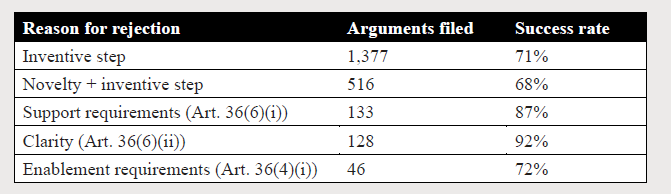
Source: analysis of 2024 JPO decisions (argument-only responses to a first Office Action).
2. How to read these figures
The similarity between the inventive-step rate (71%) and the novelty + inventive-step rate (68%) may appear counterintuitive.
On inspection, responses to the novelty/inventive-step rejection almost always dispute the Examiner’s finding on the cited invention. When that finding is overturned, the foundation of the rejection collapses, and both novelty and inventive step are frequently resolved at once.
A pure inventive-step response, by contrast, blends many distinct issues, such as the finding on the cited art, motivation, obstructive factor, design choice, and advantageous effect, each with its own likelihood of success; 71% is the average across all of them.
The success rates for support requirements (87%) and clarity (92%) are notably high.
Since the JPO is relatively strict on the support requirements, some applicants assume that a description-based objection can be resolved only by amending the claims. However, these figures indicate that an argument alone stands a very good chance of prevailing, which is an option worth trying before the claims are narrowed.
In contrast, the success rate for enablement requirements (72%) is somewhat lower, which is consistent with practitioner experience.
3. Practical takeaway
These are aggregate figures, and any individual case must ultimately be judged on its facts. Even so, the data show that a well-reasoned argument without amendment has a strong likelihood of success, particularly for description-based rejections.
It is therefore worth assessing whether a rejection can be overcome by argument alone before choosing to narrow the claims.

| We send newsletters and webinar invitations by email periodically. If you would like to receive this information, please subscribe by completing the form, or follow our official LinkedIn page. |